Manganese nodules are small polymetalic accretions scattered on the seafloor. They occur in all the oceans but only in specific and restricted settings.

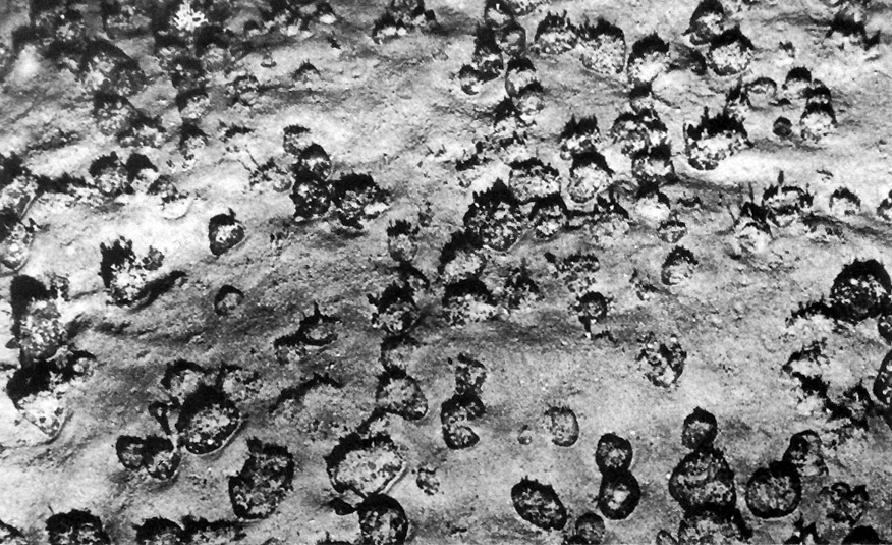
The growth of the nodules is by accretion of a succession of thin rinds on their outer surfaces. The rate of growth is extremely slow and just a few millimeters every one million years. Thus a nodule 10 centimeters in diameter may have started growing 25 million years ago and contain in its nucleus a tooth from a shark of early Miocene age. Nodules grow and survive unburied by sediment only in regions swept by currents. However, it has been discovered that many of the recovered and dated nodules had actually started growing at an age earlier than the substrate upon which the rest today. This pardox was resolved with time-lapse photography over many months that showed the sediment accumulating on the nodule being grazed and removed by ea urchins, britle stars and various worms crawling over the surfaces. The worms were then seen to burrow into the subsurface sediment around the nodules and leave the sediment in their burrows. In this manner newly arriving sediment is only permanently archived into the sediment carpet at a level many centimeters below the nodules. As a result nodules can continue to exist and grow despite a fine - but still slow - rain of sediment.
On average, manganese nodules consists of about 25% manganese, compared to 35 to 55% in commercial-grade terrestrial ore deposits. However, the nodules also contain copper (1-3%), nickel (1-2%), and cobalt (0.1-0.5%) which is comparable in grade to many commercial ores. The Manganes Nodule map is colored coded for percent copper. The region with the richest copper contents is on the floor of the Pacific Ocean between the Clipperton and Clarion Fracture zone and over ocean crust spanning 25 to 125 million years in age.
As metaliferous nodules came up in the dredges and core tops of oceanographic research scientists during the 1960s and were systematically analyzed for their mineral and chemical content in the laboratory, their future economic potential became apparent. What was needed, however, was a cost-efficient method for large-scale recovery from very deep regions of the oceans in order to compete with the costs of exploitation of land resources. In the early 1970's a rush of commercial companies began investing millions of US dollars for the technology needed to map the distributions of the nodules with highest metal contents and for the necessary mining and processing infrastructure. Cobalt was initially considered the most economically important element, although its average concentration is only about 0.25% by weight as compared to 1.5% for copper. Cobalt is a strategic metal used in super alloys, and it is especially enriched at intermidiate water depths in manganese crusts covering exposed rock surfaces on steep seamount flanks and escarpments. However, the crust is generally quite thin (just a few centimeters thick) and would be difficult to scape off and recover effectively. Over the past several decades many seabed provinces with nodules have been investigated and accessed for their resiurce potential by US and foreign enterprises. Although the US Department of Commerce has issued exploration licenses, there is no present day deep-sea mining activity for the nodules or crusts. This situation may changes in the future as rare-earth elements that are also enriched in the nodules become more in demand.
Data Sources:
External Links: