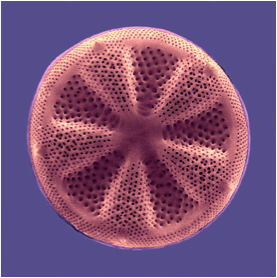
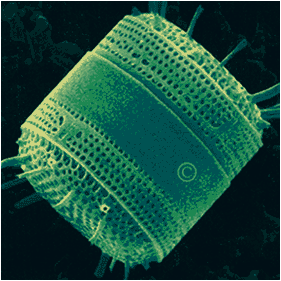
Diatoms (photos ©Dee Breger, Micrographic Arts)
The sediments that accumulate on the ocean floor are of many types with various compositions. Among the sediment particles created by plankton living in the upper sun-lit waters are tiny shells made of silica (SiO2) that we call opal. These microscopic shells (typically, smaller than a grain of beach sand) belong to radiolaria (animals) and diatoms (plants - algae).
Diatoms (photos ©Dee Breger, Micrographic Arts)
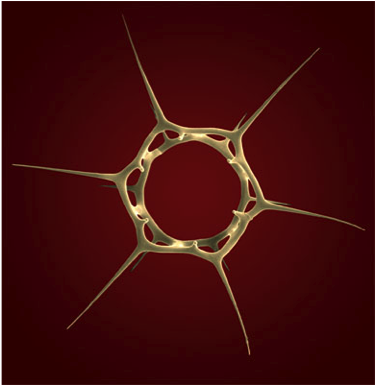
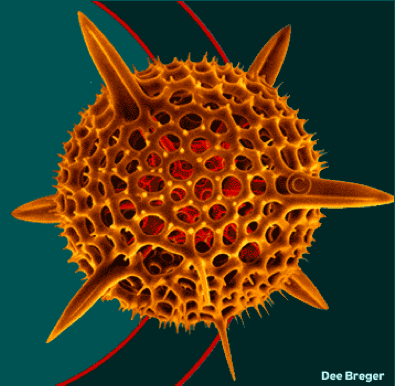
Radiolaria (photos ©Dee Breger, Micrographic Arts)
Radiolaria and diatoms are particulatly abundant in regions of high nutrient content produced by upwelling deep waters as the result of strong surface winds, such as in belts of divergence straddling the equator, offshore the western coasts of continents and associated with the circum polar currents.
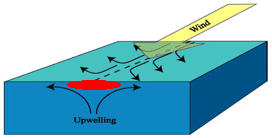
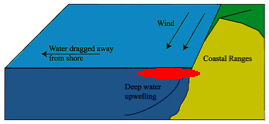
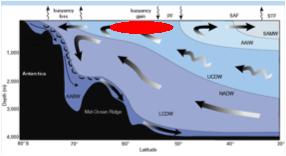
Nutrients are generally in low concentration in surface waters and enriched in deep waters. The highest nutrient concentrations are found in the North Pacific abyss which is situated as the "end of the road" for deep-ocean circulation. The abundance of biogenic (that produced by animals and plants) silica in ocean sediments is controlled by 1) the supply or "rain" of the tiny shells from the photic (sun-lit) zone, 2) the presevation of the shells from dissolution as they sink and accumalate on the seabed, and 3) the dilution of the shells within the sedimernt layers by other sediment types delivered by wind and detritus from adjacent land.
The ocean is everywhere undersaturated with respect to opal. Therefore, upon the death of the radiolaria and diatoms, their opal shells dissolve very quickly in warm surface waters. Practically all the biologically produced opal (>97%) is recycled before burial in ocean sediments. In fact more that 50% of the shells produced by the animals and plants dissolves within the upper 100 meters of the surface ocean. The opal that is eventually preserved in the sediment carpet of the ocean floor is the fortuitous consequence of very high primary productivity in the surface waters, a high export from the sun-lit ocean to the deep abyss in the fecal pellets of predators, and high-rates of sediment acumulation that result in rapid burial of the shells.
The values displayed on the map represent the the percent by weight of SiO2 on a carbonate-free bisis in the total sediment. They are from a table created by Catubig and Archer, 1999.